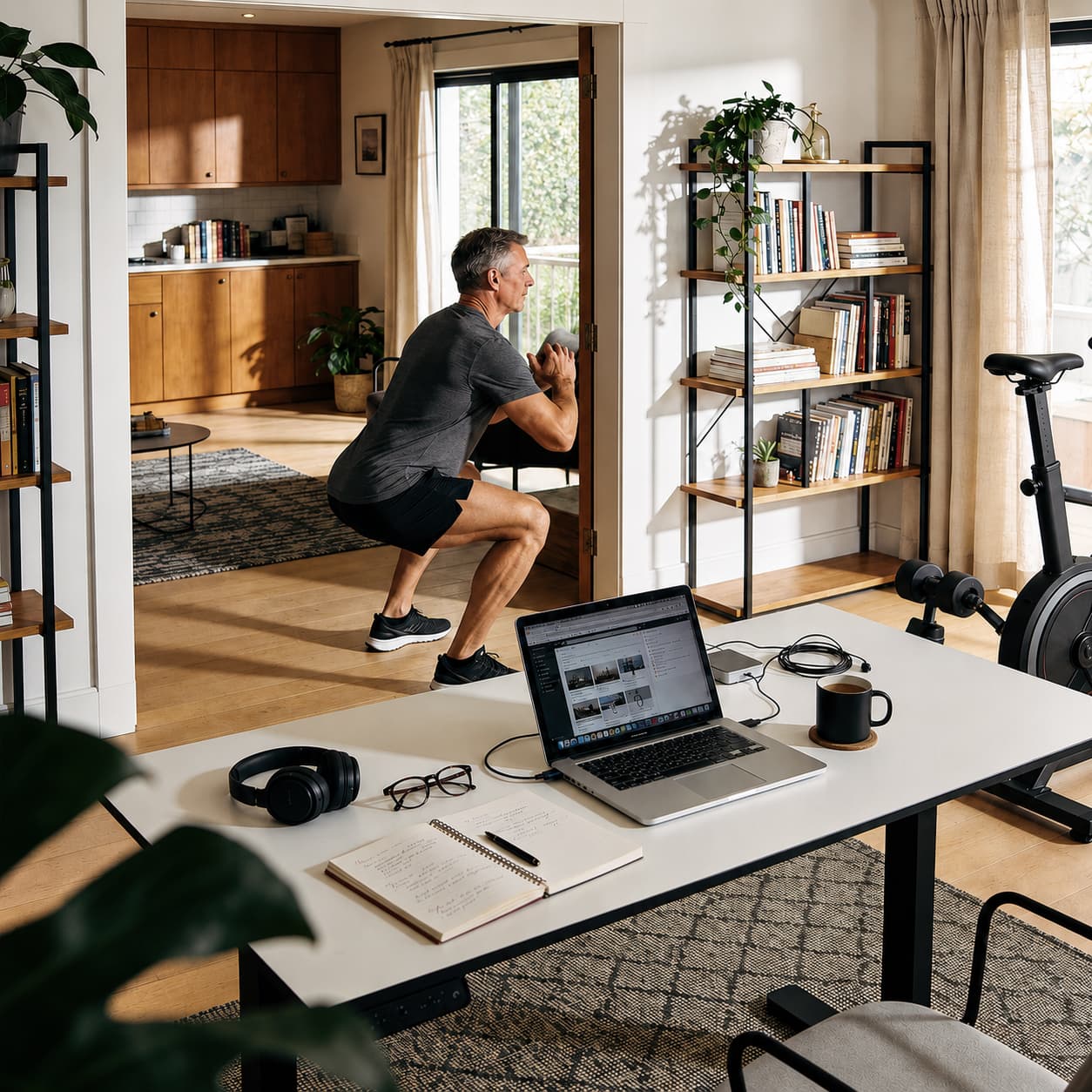
We know exercise is good for us. There are plenty of reasons to add more movement to your life, like improved cognitive health, reduced cardiovascular disease risk, and decreased risk of all causes of death.
But the notion of exercise often conjures a time-intensive activity: one that requires gearing up, driving to the gym, or booking and traveling to a class. When people can’t find time for a full workout session, they’ll hold off on exercising until they can. It’s a common mentality. But it’s also the wrong way to think about exercise.
Many Americans sit for hours on end, particularly during the work week. These uninterrupted stretches of sitting are profoundly hazardous to long-term health, increasing risks of metabolic disorders, all-cause mortality, and cancer. Even among those who exercise regularly, adults who sit for 10 hours per day have a 34% higher mortality risk according to one meta-analysis.
There is a large and growing body of evidence showing impactful health benefits can be achieved with just minutes of activity. And regular doses of non-traditional forms of exercise can serve as protective barriers from the hazards of sitting.
What is non-traditional exercise?
There’s a reason we think of exercise as a specific, time-intensive activity. Research has long focused on exercise in 30-45 minute cardio sessions, multiple times a week, performed at moderate or vigorous intensity. National guidelines for physical activity recommend at least 150 minutes per week of moderate, or 75 minutes of vigorous aerobic exercise (though they don’t recommend specific session lengths, as long as the total numbers add up).
The physiological benefits of traditional, longer-duration exercise sessions are better researched and of greater magnitude than shorter bouts, and this kind of aerobic exercise remains the foundation of any longevity-focused exercise plan. However, different, less demanding forms of exercise have a crucial role to play as well.
Consider a few pushups in between meetings. A set of lunges while waiting for a coworker to join a call. Taking the stairs—with gusto—instead of the elevator or escalator. All of these activities classify as non-traditional exercise: an infusion of movement into everyday life. That activity will vary depending on your lifestyle and preferences, but every time you interrupt your prolonged time spent seated, you’re taking a potentially life-saving measure. And the benefits add up over time.
The harms of staying sedentary
Sitting is sometimes called “the new smoking.” This claim has merit and the harms of sitting are greatest for those who do the least amount of physical activity.
But even people who engage in up to an hour per day of leisure-time physical activity (LTPA) have a greater mortality risk when they spend most of their time at work sitting. One meta-analysis identified an increased risk for all causes of death associated with 5-11 hours of time seated daily, even among people performing regular physical activity. Research suggests that 60-75 minutes of daily moderate-intensity, or 30-40 minutes of vigorous-intensity exercise is required to fully mitigate the harms of excessive sitting. This is where non-traditional exercise comes in.
Fitting exercise into your lifestyle
Non-traditional exercise, also known as leisure time physical activity (LTPA), takes many forms. It’s a great way to break up the monotony of working at a desk, or sitting at home. What’s most important is finding activities you’re most likely to repeat based on your personal preferences and current lifestyle.
Here are a few different types of non-traditional exercise, and some of the research-backed benefits.
1. Vigorous Intensity Lifestyle Physical Activity
Vigorous intensity lifestyle physical activity (VILPA) is a bout of effort that occurs outside of an exercise session. As the name implies, VILPA is done in the course of everyday life without any additional requirements besides a higher level of intentional effort. For example, climbing a flight of stairs at the office at a rapid pace, or walking very quickly to the grocery store both classify as VILPA. Carrying heavy bags from the grocery store counts, too. More moderate versions of VILPA can be performed for longer periods of time—dancing, jogging after your rambunctious dog, or playing tag with a grandchild.
What the research says
Regular but small doses of VILPA profoundly improve health outcomes. People who reported no regular exercise activity but engaged in just 4.4 minutes of daily VILPA were at 27% lower risk of all-cause mortality, 34% lower risk of dying from cardiovascular disease, and 30% lower risk of dying from cancer, according to research derived from accelerometer data in over 25,000 individuals in the U.K. Biobank dataset. In this analysis, each minute of vigorous-intensity activity (e.g. jogging, playing tag with your kid) had cardio-protective benefits that were equivalent to 7 minutes of moderate intensity activity (e.g. brisk walking, gardening). Another analysis from the same U.K. Biobank, which also included more moderate levels of lifestyle physical activity, found that every 15 minutes of moderate-to-vigorous physical activity is associated with a nearly 30% decrease in the risk of Alzheimer’s disease.
When VILPA is increased, so are its protective effects: 11 short bouts of daily VILPA led to an impressive 65% lower risk of dying from cardiovascular disease.
Short bursts of vigorous physical activity also show potential for boosting VO2 max, or the volume of oxygen your muscles can use during exercise. A high VO2 max is strongly correlated with lower mortality risk—and it can be significantly improved with continuous, moderate, or high-intensity exercise. The results with shorter bouts cannot match those of tailored, longer weekly exercise regimens, but adding in this schedule-friendly type of activity, when time simply doesn’t allow for prolonged sessions, is a wise choice.
Importantly, regular exercisers can also benefit from adding more activity throughout their day.
Though 10,000 steps is often the daily goal we hear from our fitness tracking apps and health podcasts, the majority of the benefit seems to be obtainable at somewhere between 7,000 and 8,200, with slight incremental risk reductions occurring above 10,000 steps.
2. Exercise “snacks”
Increasing the intensity of movement in daily activity isn’t the only way to hack exercise into your routine. Enter: the “exercise snack.” These are very brief breaks (less than a minute) to engage in physical activity, and can range from low to high intensity.
They’re a time efficient way to increase your activity level—once one exercise snack isn’t satiating, you can add more intensity, time, or switch up the movement.
Research suggests that activity breaks like exercise snacks can improve metabolic health compared to uninterrupted sitting, based on one meta-analysis of 17 trials. Smaller studies have also shown exercise snacks can benefit metabolic and other markers of health, but more research is required to make a determination on its effect. The documented improvements are small, and the trials are of short duration. The health benefits from exercise snacks likely accrue when incorporated into a lifestyle spanning many years.
Here are some supported exercise snack examples: A 2-minute walk; 5 push-ups; a 30-second plank; 10 air squats; 10 lateral lunges; 20 standing cross-body crunches; 30 seconds jogging in place; 25 jumping jacks.
In addition to improving metabolic health, exercise snacks might support the brain, too. Researchers found just four weeks of regularly performing three 60-second vigorous stationary running sessions on four days per week improved cognitive performance in subjects compared to the control group.
3. Interval walking
For those who like to stroll, interval walking is another great way to program additional movement into your life. To employ this technique, simply walk at your usual speed. For short bursts (timing will depend on your comfort level) speed up your pace as much as you can before returning to a comfortable speed you can sustain.
Continuous walking, even without the speed intervals, provides a range of health benefits. But interval walking training (IWT) is shown to provide additional health benefits, including increased VO2 max, improved blood pressure, and better regulated blood glucose.
Key takeaways
- In addition to your dedicated aerobic exercise sessions, aim for at least four minutes of vigorous intensity lifestyle physical activity per day.
- Try to have each bout of vigorous intensity activity last at least 1 minute. If this isn’t possible, try to work on incrementally increasing the length of each bout over time.
- When not engaging in vigorous intensity activity, aim for moderate intensity (e.g. a brisk walking pace or a slightly increased speed while climbing stairs.)
- Try to collect at least 15 minutes per day of combined moderate and vigorous intensity lifestyle activity. You’ll be significantly reducing risk for dementia, cardiovascular disease, and dying from all causes.
- Interrupt your time spent sitting down as much as possible. For every hour spent seated, incorporate some type of activity—calf raises, squats, or a brief walk.
- For a challenge, consider disrupting prolonged sitting time with an exercise snack. (e.g. a quick stair climbing session, 10 air squats, or 30 jumping jacks.)
The bottom line
Don’t strictly think of exercise as a lengthy endeavor that requires scheduling and preparation. Consider non-traditional exercise as a way to add to your long-term health bank. Any amount you can add now will help later.
Try to fit physical activity into your life—aside from dedicated workout sessions—as much as possible. Think of non-traditional exercise as something that can be sprinkled into a daily routine, like a spice or seasoning—it doesn’t have to be the main dish. You’ll still reap many of the same benefits.
To safely and effectively incorporate non-traditional exercise into your routine, consult with your doctor first.